Showing posts with label Python. Show all posts

Thursday, May 31, 2012

Blog Index

I have been writing tutorials and posting different projects for a while now, I decided to write an index for easy look up for the different post. They are divided to a few section as the follow. I hope you can find what you are looking for, if not, try to use the search feature located in the lower right side. If you have an question, please feel free to email me or leave me a message in the comment.

Python Tutorial
  • Python Reference
    A list of useful website and textbook review
  • csci133c1.py
  • Basic Hello World, declare variables, simple for loop control statement
  • csci133c2.py
  • Nested for loops, list, counting, if statement
  • csci133c3.py
  • Introduction to function, string's class function, useful tip for handling string
  • csci133c4.py
  • Opening a file, and using everything we know together. Additional to a brief review practice problem, introduce dictionary
  • csci133c5.py
    Talks about function, what are they, how to define them
  • csci133c6.py
    A taste of python's GUI, Tkinter. Introducing the title, frame, button, input widget, and what they can do with each other
  • csci133buildin.py
    Discuss what are the build-in data type (Object) in Python
  • csci133number.py
    Document Integer, Float, Long, and Complex number
  • csci133class.py
    Some notes I have on python's class, tkinter's other module
  • csci133ifelif
    Demonstration of the uses of if and elif (else-if) keyword
  • csci133c7.py
    Classic how to clean up a string and storing the string's corresponding line numbers, it discuss the use all the things we learned so far
  • csci133c8.py
    Some notes on the python's class, and subclass too
  • csci133allCombination.py
    Example of why nest while loop is bad, and how to use one if you really must have it. Plus counter solutions.
  • csci133rep1.py
    An example of how to validate input of telephone number in a specific format, demonstrating simple use of regular expression in python.
  • csci133averageGPA.py
    Simple exercise program to calculate the grade point average
  • csci133rockPaperScissors.py
    A game of rock, paper, scissor implemented in python
  • csci133clock.py
    An example of how to make a clock with tkinter in Python
  • csci133timer.py
    A tutorial on how to build a timer with tkinter in Python

Stackoverflow Goodies


C++ Tutorial

Tuesday, May 22, 2012

Python: How to make a stop watch timer using tkinter

First thing we have to understand is how the time actually work. If you do, you can skip ahead to the next section. I was not completely sure how the time work. I confirmed from the search on google and here is what it said.

1 min = 60 seconds 1 seconds = 100 centiseconds


We use the similar code as the Clock, there is a Lable (a textbox) called timeText, and we will update it every 1 centisecond, and increment our time sturcture by 1 as well. Take a look at the way it is designed.
# timer is a list of integer, in the following order
timer = [minutes, seconds, centiseconds]
Notice in the actual code it is initialized to 0,0,0. But it then created a problem of not being show as 00:00:00 as a normal stop watch would. One way to get around this is to use the string's format.() function.
pattern = '{0:02d}:{1:02d}:{2:02d}'
timeString = pattern.format(timer[0], timer[1], timer[2])

{0:02d}, the first 0 means which parameter in the format() function call, 02d means, it is expecting an integer of length 2, the 02 means it is padding with leading zeros infront of it. Take note of this feature, as it is really powerful, you can mix and match different parameters, instead of {0} {1} {2}, you can do creative things like {2} {1} {1} {2} {0}, (such as different order, multiple use of the same varaible, etc).


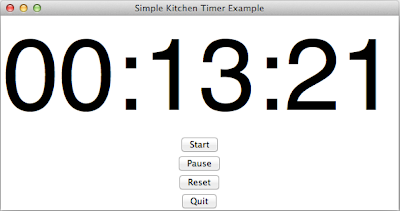
The following program contains 4 buttons (start, pause, reset, quit). Which they do what they are named after respectly. The reset function work both running and paused clock. Maybe it is a good idea to add a time lap feature?

import Tkinter as tk

# Note: Python 2.6 or higher is required for .format() to work
def update_timeText():
    if (state):
        global timer
        # Every time this function is called, 
        # we will increment 1 centisecond (1/100 of a second)
        timer[2] += 1
        
        # Every 100 centisecond is equal to 1 second
        if (timer[2] >= 100):
            timer[2] = 0
            timer[1] += 1
        # Every 60 seconds is equal to 1 min
        if (timer[1] >= 60):
            timer[0] += 1
            timer[1] = 0
        # We create our time string here
        timeString = pattern.format(timer[0], timer[1], timer[2])
        # Update the timeText Label box with the current time
        timeText.configure(text=timeString)
        # Call the update_timeText() function after 1 centisecond
    root.after(10, update_timeText)

# To start the kitchen timer
def start():
    global state
    state = True

# To pause the kitchen timer
def pause():
    global state
    state = False

# To reset the timer to 00:00:00
def reset():
    global timer
    timer = [0, 0, 0]
    timeText.configure(text='00:00:00')

# To exist our program
def exist():
    root.destroy()

# Simple status flag
# False mean the timer is not running
# True means the timer is running (counting)
state = False

root = tk.Tk()
root.wm_title('Simple Kitchen Timer Example')

# Our time structure [min, sec, centsec]
timer = [0, 0, 0]
# The format is padding all the 
pattern = '{0:02d}:{1:02d}:{2:02d}'

# Create a timeText Label (a text box)
timeText = tk.Label(root, text="00:00:00", font=("Helvetica", 150))
timeText.pack()

startButton = tk.Button(root, text='Start', command=start)
startButton.pack()

pauseButton = tk.Button(root, text='Pause', command=pause)
pauseButton.pack()

resetButton = tk.Button(root, text='Reset', command=reset)
resetButton.pack()

quitButton = tk.Button(root, text='Quit', command=exist)
quitButton.pack()

update_timeText()
root.mainloop()

Python: How to make a clock in tkinter using time.strftime

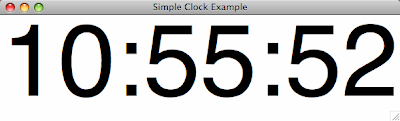
This is a tutorial on how to create a clock / Timer using tkinter in Python, note you might have to change Tkinter to tkinter depending on your version of the Python you have. I am using Python 3.2 at the moment. The code itself is quite simple, the only part you need to know is how to get the current time, using time.strftime. You can also get the day of the week, the current month, etc, by changing the parameter you are supplying the function. (See the link for the full table of possible options). But yes, almost anything you can think of any use of, it is there already. :) So this can actual be developed to a calendar like GUI.

Related Tutorial with source code
Stop watch GUI (for counting time): http://ygchan.blogspot.com/2012/05/python-stop-watch-timer-source-code.html


import Tkinter as tk
import time

def update_timeText():
    # Get the current time, note you can change the format as you wish
    current = time.strftime("%H:%M:%S")
    # Update the timeText Label box with the current time
    timeText.configure(text=current)
    # Call the update_timeText() function after 1 second
    root.after(1000, update_timeText)

root = tk.Tk()
root.wm_title("Simple Clock Example")

# Create a timeText Label (a text box)
timeText = tk.Label(root, text="", font=("Helvetica", 150))
timeText.pack()
update_timeText()
root.mainloop()
Reference: http://docs.python.org/library/time.html#time.strftime
Reference: http://docs.python.org/library/string.html#formatstrings

Saturday, April 7, 2012

Python: How to insert characters to the string at the end

Reference: http://stackoverflow.com/q/10059554/1276534
Credits: user1319219, Akavall, Mark Byers

Just in case you wondering what are the ways to insert character to the string at the front or back (beginning or end) of a string. Here are the ways to do it. Notice, string is immutable object, so you can not insert anymore characters into it. All we are doing is create a new string, and assign it to the variable. (That's why I did not use the same name, because I want to emphasize they are NOT the same string). But you can just as well use text = (any method)

# Create a new string that have 1 x in the beginning, and 2 x at the end
# So I want the string to look like this 'xHello Pythonxx'
text = 'Hello Python'

# Method 1, string concatenation
new_text = 'x' + text + 'xx'

# Method 2, create a new string with math operators
i = 1
j = 2
new_text = ('x'*i) + text + ('x'*j)

# Method 3, use the string's join() method
# You are actually joining the 3 part into a originally empty string
new_text = ''.join(('x', text, 'xx'))
And in case you don't trust me and want to see the output:
xHello Pythonxx
xHello Pythonxx
xHello Pythonxx

Python: How to find the integer and float in a string

Reference: http://stackoverflow.com/a/10059001/1276534
Credits: MellowFellow, hexparrot

If you have a string from somewhere, say a textbook, or an input. The string contain the data information you need. How do you extract the string? There are quite a few way to do it, range from hard code accessing it from index, to finding the E=, to using regular expression. In this example we will go over the middle of the range one. Because as beginner, it might not be the best idea to introduce regular expression yet. Plus this is the version I understand, maybe the regular expression version will be provided soon. (If you can't wait, you can check out from the reference link from above, there is the regular expression solution as well.)
# Assume you get this string from either a file or input from user
text_string = 'The voltage is E=500V and the current is I=6.5A'

# The starting index of this locating the voltage pattern
voltage_begin = text_string.find('E=')
# The ending index, note we are ending at 'V'
voltage_end = text_string.find('V', voltage_begin)

voltage_string = text_string[voltage_begin:voltage_end]
print(voltage_string, 'is at index:', voltage_begin, voltage_end)

#Since we know about the first to index is not useful to us
voltage_string = text_string[voltage_begin+2:voltage_end]

# So since now we have the exact string we want, we can cast it to an integer
voltage_as_int = int(voltage_string)
print(voltage_as_int)

Python: How to search a list of class element by their data (self.name) variable

Reference: http://stackoverflow.com/q/10052322/1276534
Credits: nitin, kindall

Imagine you have a class of Food, and you want to create a list that store your class of Food. How do you search your class element within your list? Take a look at the code.
class Food:
    def __init__(self, name):
        self.name = name

chicken = Food('Egg')
cow = Food('Beef')
potato = Food('French Fries')

# And then you create the list of food?
myFoodList = [chicken, cow, potato]
The way you want to implement your class so you can search through them by their name variable is done via dictionary. (This is one way to do it, set also might work depend on your class's implementation and required functionality).
class Food:
    lookup = {}
    def __init__(self, name):
        self.name = name
        Food.lookup[name] = self

chicken = Food('Egg')
cow = Food('Beef')
potato = Food('French Fries')

# Example of a lookup from the dictionary
# If your name is in your class Food's lookup dictionary
if 'Egg' in Food.lookup:
    # Do something that you want
    print (Food.lookup['Egg'].name)

Friday, April 6, 2012

Python: How to remove, or pop an element randomly from a list

Reference: http://stackoverflow.com/q/10048069/1276534
Credit: Henrik, F.J, Óscar López, Niklas B.

Assuming you want to randomly remove an element from your list, you can use the random module, to generate a random number, between the valid index in your list. Take a look at the code below.
# Import the random module
import random

# This is your list with some number
# But you can of course have anything you in your list
myList = [1, 3, 5, 7, 9, 11]

# Method #1
myList.pop(random.randrange(len(myList)))

# Method #2 (This one will change your list)
random.shuffle(myList)
# While my list is not empty
while myList:
    myList.pop

(Method 1) Let's studying this code from the inner to the outer layer.
  1. We get the length of the list, with my len(myList)
  2. Then we call randrange(), what randrange does it return a number that is pick randomly between the range we provide it. But except we do not actually create this list. Like range() would.
  3. Then finally we pop it from our list.
(Method 2) This will be good, if you want to use your list all together, instead of just popping one element. This is used in the csci133 example in the playing deck, since you have to shuffle your whole deck and then pick 1 card at a time. It make sense to have it shuffled.

    Thursday, April 5, 2012

    Python: When NOT To use Global Variable, Use Return!

    Reference: http://stackoverflow.com/q/10036747/1276534
    Credit: Ricky, jdi, Maty

    Using global variable in your Python function is really easy, but today I read a post that explain why not to use it. And I found it make a lot of sense, I am not used to write without the pass by reference. Take a look at this code below.
    def getSalary():
        global a, b, c
        a = input("Please enter the boss's salary")
        b = input("Please enter the director's salary")
        c = input("Please enter the factory worker's salary")
    

    Notice this function, it asks the user for 3 different salary and store them in a, b, c respectively. But it is not a good practice, instead we should use the return function.

    def getSalary():
        a = input("Please enter the boss's salary")
        b = input("Please enter the director's salary")
        c = input("Please enter the factory worker's salary")
        return a, b, c
    
    # And to way to use this function is like
    a, b, c = getSalary()
    
    This make the code a lot more readable, and useable. Imagine if you make a mistake in the program, if you use global variable, you will have a very hard time tracking where exactly does your value get changed. While doing it the second method, you will know a, b, c is changed on the getSalary line's return. And you can print them as you writing your program to debug it.

    And as jdi pointed out, it is always always better to use more meaningful variable name than a,b,c,d, or x,y,z. Imagine you use bossSalary, directorSalary, factoryWorkerSalary, the code is a lot easier to understand. Granted, maybe a little bit long. But maybe you can use workerSalary at least!

    And when you have a function that modify your object, such as your own class, a list. Maybe (depending on the situation), you might want to create a new variable and assign it, or you can overwrite it too!
    def newSalary(salary):
        return salary + salary * 0.02
    
    # Use it like this
    nextYearSalary = newSalary(salary)
    # Or overwrite the old one
    mySalary = newSalary(salary)
    

    Tuesday, April 3, 2012

    Python Tkinter: How to set the window size without using canvas

    Reference: http://stackoverflow.com/q/9996599/1276534
    Credit: George, Bryan Oakley

    Here is the code on how to set the window size without using canvas, it is great if you just starting, or do not want to use canvas to do this. You can specify your dimension in your frame, and then use pack_progate(0) flag to tell tkinter to use your size.
    import tkinter as tk
    
    root = tk.Tk()
    frame = tk.Frame(root, width=400, height=400)
    frame.pack_propagate(0) # set the flag to use the size
    frame.pack() # remember to pack it or else it will not be pack
    
    textBox = tk.Label(frame, text="(x,y): ")
    textBox.pack()
    
    root.mainloop()
    
    Note: If your frame is not big enough to how the items, it will expand to fit your items). And the pack_progate(0) is a flag, it does not replace pack() method, you still have to call it or otherwise it will not appear. Hope this help.

    Reference: stackoverflow 1, stackoverflow 2

    Monday, April 2, 2012

    Python: [] vs. {} vs. ()

    Reference: http://stackoverflow.com/q/4407873/1276534
    Authors: Zolomon, Greg Hewgill, Andrew Jaffe

    It is a good note post to make sure we remember what is [] vs. {} vs. ()

    () - tuple

    A tuple is a sequence of items that can't be changed (immutable).

    [] - list

    A list is a sequence of items that can be changed (mutable).

    {} - dictionary or set

    A dictionary is a list of key-value pairs, with unique keys (mutable). From Python 2.7/3.1, {} can also represent a set of unique values (mutable).

    Python: Regular Expression 101 Example Code

    Reference: http://stackoverflow.com/q/9980381/1276534
    Authors: Rajeev, George

    In computer science theory class, we learned about regular expression. But it is unclear what exactly can it do at first, today I would like to introduce data validation as an example that uses the concept of regular expression. Python itself, like other language I assume (heard), has an implementation of regular expression. It comes standard from python too, see: http://docs.python.org/library/re.html

    For example, you would like to ask the user for a telephone number, in the format of: 917-222-1234, if it is not in the format of XXX-XXX-XXXX, it will ask the user again until it is store. Let's take a look at the sample code.
    import re
    
    while True:
        # Get the user's input into the string
        myString = input('Enter your telephone number: ')
        
        # Matching it with the regular expresssion
        # isGoodTelephone will return True if it matches
        isGoodTelephone = re.match('^[0-9]{3}-[0-9]{3}-[0-9]{4}$', myString)
        
        if (isGoodTelephone):
            print('Great! Got your phone number into the system')
            print('Entry:', myString)
        else:
            print('Not in the correct format. Ex: xxx-xxx-xxxx')
        print()
    
    
    Output of the csci133rep1.py:
    Enter your telephone number: 917-123-1234
    Great! Got your phone number into the system
    Entry: 917-123-1234
    
    Enter your telephone number: 9171231234
    Not in the correct format. Ex: xxx-xxx-xxxx
    
    Actually the basic of the regular expression is not too hard to learn, take a look at the bottom and you will able to figure out how to use it with no problem. Didn't need to put too much comment to make it understandable. Although there are much more ways to use it than just the telephone.
    ^[0-9]{3}-[0-9]{3}-[0-9]{4}$
    ^       # mark the start of the telephone string
    [0-9]   # any one of the 0123456789
    {3}     # match it exactly three times, no less
    -       # a hyphen symbol
    [0-9]   # any one of the number between 0 and 9
    {3}     # exactly three copies
    -       # another hyphen symbol
    [0-0]   # any one of the number 0-9
    {4}     # four times
    $       # mark the end of the telephone string
    

    Tuesday, March 27, 2012

    csci133ifelif.py

    Reference: http://stackoverflow.com/questions/7052393/python-elif-or-new-if
    Today when I am reading on the python exercises, I came across one of the exercise program it uses elif (in chapter 10). For a second I am not sure what does it mean because it is called differently. But when I read closely to the source file. It looks like it is trying to replaces some of the other if else statements. Finally I look it up online, I found out it is a little bit more than just if else loops.
    def foo(var):
        # Check if var is 5
        if var == 5:
            var = 6
        elif var == 6:
            var = 8
        else:
            var = 10
        return var
    
    def bar(var):
        if var == 5:
            var = 6
        if var == 6:
            var = 8
        if var not in (5, 6):
            var = 10
        return var
    
    print foo(5) # 6
    print bar(5) # 8
    
    You can see the exam of foo(5), if the val is 5. Then the rest of them are treated as (else) loop. The elif is a nested else if loop. It is good (maybe) if you want a cleaner looking program, because you don't have the nested else if loops, the indent level is smaller, and faster compare to a sequence of if, if, if statements, because you are not checking explicitly for every single if statement. Note: always try to put the most common condition on the top, so things can check off the 'list of conditions' faster.

    For example: If you want to check if a string is English word or not, you would want to check if "isalpha()" or not, and then you start to clean up the letters. So that way, your loop will exist as soon as it knows it contain non-letter characters.

    Thursday, January 5, 2012

    csci133c1.py

    In the first program we are going to start with "Hello World", in python it is actually really simple to do. Type the below code into the file, and press save and run!
    # Example: Hello World
    print('Hello World! Python is fun!')
    Output:
    Hello World! Python is fun!
    Notice in the single quote signs, what is between ' ' is viewed as a sequence of characters. Unlike in C++, python is an interrupt language, we don't need to complie, we just need to save and run it. (Control + Save) Then (F5) And in python, you can comment with " # " sign, the python will not do anything to that line, it is for reference and notes. It is always good habit to document your code, and keep the comments outdated when you make changes.

    Let's create a string variable name food, and we print "I like that food".
    # Example: Printing with variable
    food = 'cookies'
    print('I like', food)
    
    Output:
    I like cookies
    Here there we learn two things, one is the way the python declare the variable, without a type. It takes care of figuring out what is the type, base on what you give it. In this case the food is a string variable, and the way to include the variable in the print, we separate it with a comma (,).  And let's take a closer look at the first line, the equal sign does not mean food is equal to cookies, rather it mean we assign cookies to the object data named food. There is a difference there, it would be best if we read it as, "food is the name of the string for cookies", or "cookie is now food" in our program. Below is another example to demonstrate how to use a few variable at the time in the print.
    # Example: What do you eat everyday?
    breakfast = 'milk'
    lunch = 'burger'
    dinner = 'steak'
    print('I eat', breakfast, lunch, dinner, 'everyday.')
    
    Output:
    I eat milk, burger, steak everyday.
    This example we can see we can chain more variables in the print statement, you can do it with different variables if you have other. And take a note on the following piece of example, guess what is the output?
    # Little Quiz 
    breakfast = egg
    print('Today"'"s breakfast:', breakfast
    breakfast = sandwich
    print('Today"'"s breakfast:', breakfast
    Can you guess what is the output?
    Here is the answer!
    Today's breakfast: egg
    Today's breakfast: sandwich
    If you guessed correctly, good job! And if you wonder why I used double quotes ( " ), it is because it is the only way to print single quote. You need to wrap the single quote in a double quotes. "'". Try it and see if it works!

    But it is kind of hard to type out all this, if we have many many different kind of food for breakfast, what if we have 5 different foods, do we need to write 5 identical print lines? The answer is no! Check out the following example.
    # Simple for loop example
    foods = ['egg', 'juice', 'apple', 'bread', 'cookies']
    for food in foods:
        print('Today"'"s breakfast:', food)
    Output
    Today's breakfast: egg
    Today's breakfast: juice
    Today's breakfast: apple
    Today's breakfast: bread
    Today's breakfast: cookies
    Don't you think it is a lot easier this way? And feel free to type your own favorite food for breakfast. For these who are new to python programming, there is actually a lot going on in this example.
    1. The object we created in the example above is a list, in this case it is a list contain 5 string objects, a list is a sequence of objects. We create list in python by separating the string objects with commas, and enclose the sequence with square brackets. Another example of a list contain 2 student: ['Sam', 'Kelly']
    2. You can create a list of other types too, with integers, whole numbers, such as 1, 2, 3, 4, 5, including negative numbers too. Example: dates = [1, 5, 12, 19, 20]. We have here a list object name dates, containing 5 integers.
    3. There is control statement, or as call it, a for loop. The structure of the statement is like this:
      # Example for a for loop control statement
      for object in objects:
      <Indentation> statement
      <Indentation> statement
      The python only know the statement is "inside" a loop when you indent it, otherwise it has no way of knowing. It is different from say other language like C++, as they use {} to create a block of code. And although we don't have to end every single statement with " ; ", but in the case for the loop, we need to add a colon " : ", to let python know this is the end of the condition. I provide readers with a few more example here:
      # Always object for object(s)
      for line in lines:
      <Indentation> statement
      
      for car in cars:
      <Indentation> statement
      
      for class in classes:
      <Indentation> statement 
    However, python doesn't care what name we use, just like in other programming language, the name (identifier) is for the programmers (human) to read. So there is nothing stopping you to do something silly like this.
    # A really bad example
    aawhjwb = [1, 5, 20, 55]
    for bbb in aawhjwb:
        print('Visit doctor at: ', bbb, 'of this month')
    But it will be very hard to remember what is going on, so try to use something that make sense, that way it is easier to debug and for other programmers to read your code. Please do not do not do this.

    Practice Problem:
    Write a program that produce the following output:
    Tip: Create a list contain 3 student's name.
    Hello George
    Hello Peter
    Hello Joe
    
    Write a program that produce the following output:
    Tip: To print an empty line, do print(), this will produce an empty line
    Red Car
    Red Truck
    Red Tank
    Red Boat
    
    Blue Car
    Blue Truck
    Blue Tank 
    Blue Boat
    
    Green Car
    Green Truck
    Green Tank
    Green Boat